The Legend of Farmer Brown
By Gary S. Hatrick
There are teachers whose impact on your life may be felt decades after you sat in their classes, or, as in the case of Rob Brown, years after you walked through his barn or planted his field or repaired his fence or milked a cow or fattened a hog.
Brown, 75, was an agriculture teacher at Zephyrhills High School. If you see an ag student from Zephyrhills showing a steer, dairy cow, hog, or sheep, at least one of the student’s parents was probably one of Brown’s students. Not that all of his students are now found in barns and among fields and streams, many didn’t stay on the farm. His legacy is felt among “highly-skilled” professionals as well as among “highly-skilled” turners of wrenches and planters of crops.
Brown did not set out to be a teacher. He was born in Athens County, Ohio, where his father had a tree nursery and farm. “I grew up working on the tree farm with dad,” he recalls. “I farmed, raised, and planted lots of things, starting at 10 years old. I spent my spring breaks and the summers planting Christmas trees or pine trees and locust trees on old strip mines and reclaimed farms and stuff like that. When I graduated from high school, I got my commercial truck driver's license and I drove coal out of the strip mines for a year.”
“I started farming in this area of the Hocking River Valley. It’s so poor, you have to do a lot of things to try to make a living,” Brown said. At one time, to supplement their income, he and his father spent time buying old houses being displaced by a state highway, moving them to new locations, and selling them for a profit. The farm, in the meantime, did not go well.
“I was raising corn and soybeans, and I had a hundred acres of corn and a couple hundred acres of soybeans on my own and in Hocking River Valley, and three years in a row, they washed away within a couple of hours. You farm these old river valleys up here, and it's just a gamble. I just gave up and moved to Florida.”
The farm failed from 1977 through 1979. In the 80s, Brown was in Florida selling John Deere and Kubota golf course equipment. At the time, Alan Knight, former Pasco County Schools principal, coach, and Zephyrhills City Council member, went to the same church as Brown. He approached Brown with a proposition. “He was assistant principal at Pineview Middle, and he needed an ag teacher,” Brown recalled. “The ag teacher at Pineview came in and said, ‘Look, I'm pregnant. I'm gonna have a baby, so I'm gonna take the year off.” They didn't have an ag teacher. So Alan talked to me and I went over and interviewed, and he wanted to hire me, but then they called me back and said, ‘Rob, we can't hire you. You don't have a four-year ag degree.’ ”
The need for an ag teacher was critical, so they arranged for Brown to agree to take six credit hours per year while he was teaching until he obtained a degree. “I said I'll give her a shot, so I went to work,” Brown said. “Anyway, I got 'em up, I got 'em going. I was teaching sixth, seventh, and eighth graders at Pineview Middle for the 92,’93 school year. I had a lot of training with my own kids, working with animals and the FFA (Future Farmers of America), and showing animals and that kind of thing. I was having fun with it.”
Toward the end of the school year, Knight called him and said, “Rob, I gotta tell you, they need you at Zephyrhills.” The teacher there was resigning. “I went over there and started. My daughter graduated in June of ’93, and I started there in July of ’93,” Brown recalled. “I was there for 24 years.”
The central core of Brown’s teaching was to make sure students graduated with practical skills so they could support themselves. “My background was working hard and struggling to survive. I understood that at that time, most of the kids in Zephyrhills came from blue-collar families or working families. Jobs were important,” Brown said. “The main thing for me was I wanted to make sure when they graduated, that these kids had job skills or something so they could go to work right off, because I knew most of 'em would never go to college or if they did, they wouldn't finish.”
“I worked with guidance counselors, and there were a lot of times they'd bring kids to me that couldn't do well, that weren't getting along in other classes, and I would get along perfectly fine with ‘em because I understood ‘em,” Brown continued. “I didn't wanna be shut up in a room all day. I didn't wanna be shut up with a book shoved in front of me. I wanted to be doing something.”
Brown relates the story of a local plumber who called and asked him if he had someone who might make a good apprentice plumber. Brown sent a young man along, and two decades later, he owns his own plumbing company. He helped another young man to go to work for a local lawn mower engine repair shop and today he owns a business working on airplane engines.
But not all of his students are farmers and plumbers and mechanics. He has students who work in veterinary medicine, dermatology, thoracic surgery, law, cancer research, and a multitude of other jobs. What they have in common is that they learned to work hard.
Sometimes parents did not understand. “They’d look at agriculture class and say, ‘Well, my kid's not gonna be a farmer.’ I wasn't teaching 'em to be a farmer. I was teaching them skills that they could use.”
It was not unusual for him to incorporate planting a field of hay, building a fence on the school farm, or fitting out a new pole barn to give the students practical experience in problem solving and ingenuity.
He is concerned about how ag programs are being run in today’s technological world. “Today, they're converting science teachers to ag teachers, and they're nice people, but they have really no farm experience,” Brown said. “They haven't been out planning a field at three o'clock in the morning, and they haven't been out there and watched their crop wash away, so they really don't understand true farming experience and adaptability.”
In addition to his classroom work, Brown would help students obtain animals for show at the Florida State Fair and the Pasco County Fair. Many times, he stood in place of their parents, who had to work to see to it that the students' projects were being handled correctly. He taught them how to care for their animals, how to groom them and show them, and many times, how to win the first-place ribbon. He helped found the Building Legacies 4H Club to help foster appreciation of agricultural skills in future generations.
Brown also headed up extra-curricular activities to help raise funds, provide experience, or improve facilities for the agricultural studies. The “Nut Hut” is one project many will remember, especially if they were regular attendees at the Bulldog football games. It was a portable “storefront” where ag students and Brown would prepare and sell boiled peanuts to raise funds. He also arranged for peanut sales at the Pasco County Fair.
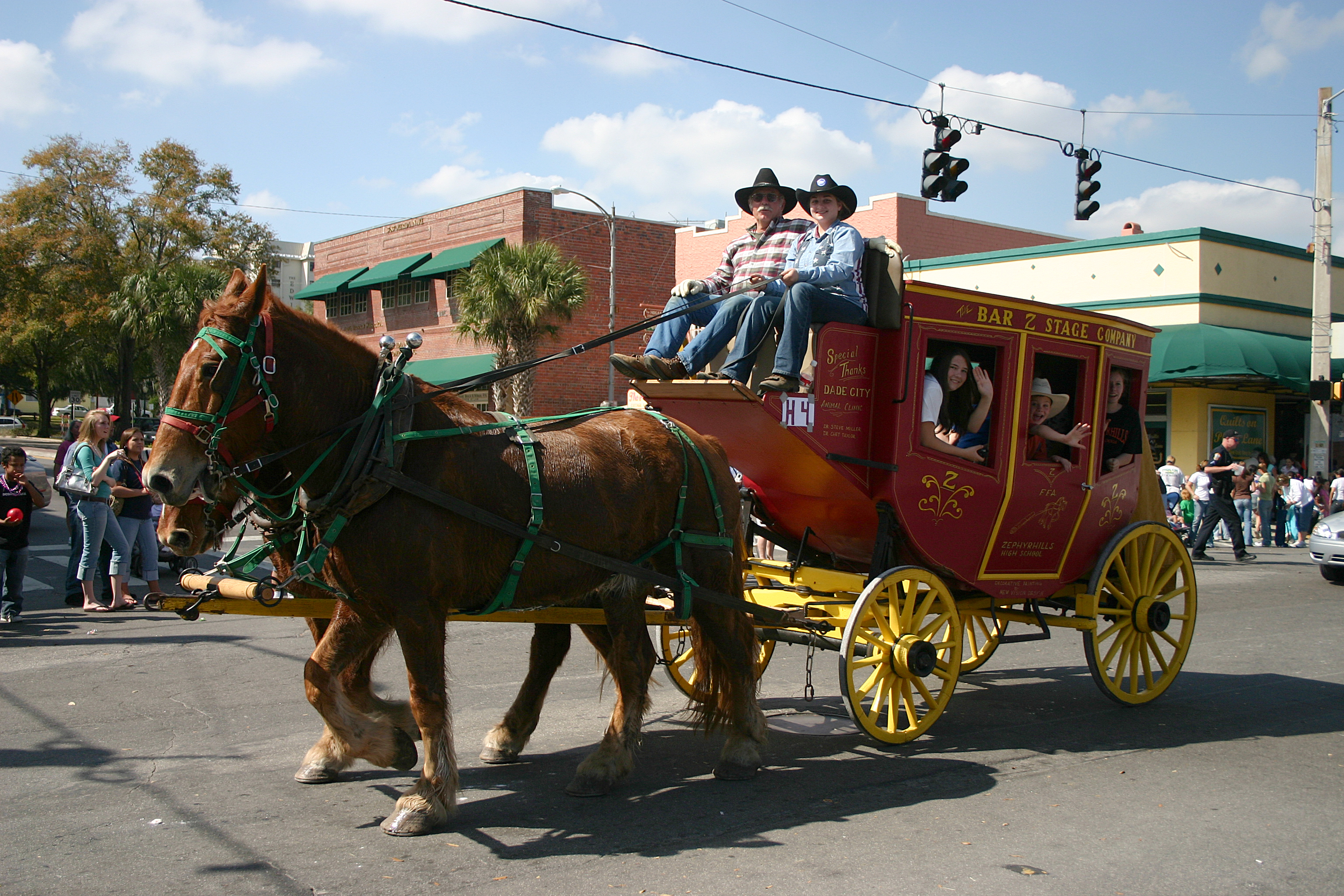
In parades, he used to drive a stagecoach that he and his students rebuilt and used on loan to promote the agricultural programs at ZHS.
Speaking of learning skills and adaptability, He tells the story of driving the stagecoach at the Little Everglades Steeplechase that used to be held north of Dade City: “I had these old logging horses and when you first hitched them up, they wanted to pull, like they was pulling a log and you had to take 'em out somewhere and work the kinks out of 'em for about a half an hour before you went in the parade. Well, we went up there (Little Everglades Steeplechase) and we got on the stagecoach, ready for the parade. Too late, I realized one of the lines was wrapped around the horse collar, and so I had no control over 'em. They took off with us on the stagecoach straight for the lineup of several brand new Mercedes that were waiting to get in the parade. “Oh, I thought, we're gonna destroy these Mercedes with the stagecoach, and luckily for me, when the horses got up to the Mercedes, they just stopped dead. My girls, being horse girls, were used to working with horses. One of them brought up and grabbed the lines and got 'em untangled, and we didn't have any more accidents.”
Once he gets started, Brown can tell you a lot of stories and many of them are about the pride he has in his students’ accomplishments.
Brown retired from the ag program at Zephyrhills High School in 2015 at the age of 65, but what about his degree?
“One of the most surprising things for me, it took me 10 years to get my four-year degree,” Brown said. “I graduated from the University of Florida when I was 52 with an ag education degree. I did not know it until after I graduated that my dad also had an ag education degree. My son Eddie also graduated from the University of Florida with an Animal Science degree and then got his master's in Ag Education at the University of Missouri, so actually we have three generations with ag education degrees.” His children are both involved in agriculture. Eddie is a county extension agent, and his daughter Molly lives in Texas on a ranch with her husband.
While Brown has received honors, like Teacher of the Year one year, his greatest joy comes from knowing what his students have done with their lives. “It was always more important to me for the students to be successful,” he said.
But he does enjoy being remembered by those students. “A couple of weeks ago I had dinner at a Longhorn Steakhouse, and I got ready to pay, and the girl and the waitress said, ‘No, no, no. put your money away. Your bill's already paid.’ I started to look around, and she said, ‘They're not here, they already left. They said not to tell you who it was.’ That's the nice thing. I've been out for 10 years and have somebody care enough to buy my dinner and just anonymously, you know?”
We do know. You’re a living legend, Farmer Brown.